Showing posts with label Hindi. Show all posts

Monday, April 5, 2010

Tum Milo To Sahi Movie Review


Story:Tum Milo To Sahi is a tale of ordinary people at different stages of life, who discover that ‘their roots have intertwined so inseparably that they have become one tree and not two!’ The film revolves around ‘art and fortunate accident’ happens to three different couples at threedifferent stages of life – late teens, mid thirties and late fifties. The three couples either in the ‘breathlessness of being in love’ or missing ‘that excitement’. Wherever they may be to begin with, the journey of life makes them discover true love – that which is left over, when ‘being in love’ has burned away. Tum Milo To Sahi is a look at how that love makes the lives of these ordinary people, extra-ordinary!

Where have you been, Nana? And why don't we see more of you, Dimple? These are the two questions that primarily stare you in the face as you sit through Tum Milo Toh Sahi, a sweet little ode to the spirit of the quintessential Mumbaikar who manages to connect, communicate and build lasting bonds in the milling crowds. The two veteran actors create such a warm picture of humaneness, warmth and togetherness, it leaves you asking for more. And the fact that they are total opposites -- he's Subbu, the reclusive, angry, Tamilian and she's Delshad, the delightful, exuberant Parsi -- makes the bonding crackle and shine some more.

Ever since their first meeting which begins with a fight in a mall, the duo take you by the scruff of your collar and make you sit up and watch them as they chart out a friendship graph that weaves through unchartered territory. Like, Nana playing the violin in his dead mother's room, while Dimple watches or Dimple trying to convince him to open up his house, and himself too, to let in some fresh air. Eventually, Nana does play crusader and try and save her cafe from the land sharks, but it is the smaller nuances and the several unsaids between the adult couple which makes for compelling viewing.

The other actors too manage to create some firmly-etched cameos. There's Suneil Shetty and Vidya Malvade, the discord-ridden couple who are on the verge of a split. And there are the mass communication students, Rehan Khan and Anjana Sukhani, who may or may not transform their fuchha-senior relationship into something more. Bringing them all together is Dimple's corner house cafe, with its bun-muska, its caramel custard and its `We are the world-We are the children' spirit.

Director Kabir Sadanand picks up a simple story and tells it well. And as he does, he touches upon the new trend of the common-man-as-crusader which seems to have taken India by storm currently. More importantly, he captures the `melting pot' syndrome of our very own maximum city with a treacly tenor that does spread some sweetness in the harsh political reality. A bit of editing needed, however, for the film does tend to ramble a bit, specially in the song and dance sequences. Nevertheless, there's enough to hold your attention....Watch it for the veterans' winsome act, the spirit of Mumbai and for a tale told well.

Monday, March 29, 2010

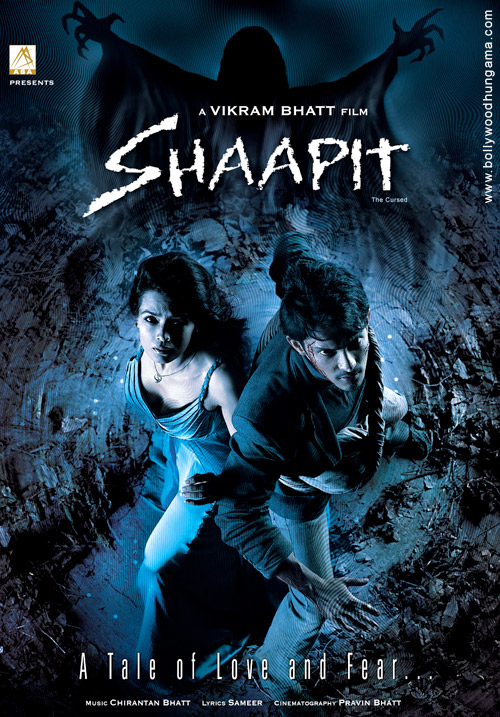
Shaapit's Review

Vikram Bhatt's penchant for the horror film finds another exposition with Shaapit, supposedly the third in the trilogy initiated with the blockbuster Raaz, followed by 1920. This one falls somewhere between the chutzpah of Raaz and the picture-postcard perfection of 1920. It is definitely more gripping than 1920, though it fails to draw you into the drama like the two Raaz sequels. Nevertheless, there's enough to keep the interest running, although we would wish the Indian horror film would somehow extricate itself from mumbo-jumbo, mantra-tantra.

Vikram Bhatt does try to give a more scientific bend to the proceedings by bringing in an erudite professor (Rahul Dev) to unravel the mystery of the ghost who travels through time and prevents the girls from a certain family from entering into wedlock. The Professor helps youngster Aman (Aditya Narain) to find a cure to the curse which plagues his girlfriend (Shweta Agarwal) and sends her into a coma after a chilling tryst with the evil spectre. He takes him on a journey to the distant backwaters and their search ends up in a spooky jail, where the plaster-peeling walls have their own sordid tales to tell. The present day story is basically anchored in two stories from the past and provides ample scope for the film maker to parade kings, princes and scheming queens before the special effects set in.

The film works not so much due to its story. Rather, it's the way Vikram Bhatt tells his story -- with a certain polish and pizzazz -- that draws you in. Also, it's Pravin Bhatt's multi-hued cinematography which adds a lyrical quality to the film. Not much of a debut however for Shweta Agarwal, who spends much of the screen time in comatose, though Aditya Narain is adequate. Watch it, while you wait for our own Paranormal Activity.

Saturday, March 27, 2010

Hum Tum Aur Ghost Review

Story: Fashion photographer Armaan has too many problems at hand. There's a high maintenance girlfriend, Gehna who is the editor of the fashion magazine he works for and a plethora of ghosts who want him to fulfil their wishes, since only he can see and communicate with them. Things get even more complicated when Gehna begins to hate the other worldy intrusions and actually doubts her boyfriend's mental health....

Movie Review: Arshad Warsi's debut film as writer and producer has a problem at the onset. It fails to define itself. Is it a comedy, a love story or a supernatural drama? Does it have a point to make, other than entertain?

The first question raises its head because the plot and the tenor of the film ramble too much. Rarely funny, mostly sentimental, the film seems to waste away its comic potential for some drama that doesn't quite engage. While the encounters with the ghosts, headed by Boman Irani, begin in a lighter vein, they suddenly seem to enter touch-feely territory, with Arshad Warsi, the guy who can see dead people, shedding copious tears while bringing together sons and fathers, sons and mothers, husbands and wives. Case in point: Suddenly, out of the blue, you have a little boy ghost running across crowded streets, urging Arshad to save his dying daddy. Hello! Where did he come from; what's his story? They do tell you, but it's too abrupt and makes you wonder why Arshad is weeping his way through a sequence that barely touches you. Again, the mother ghost hunting for her four-year-old son is too soppy and too predictable. The only ghost-ghost ka dost sequence that actually works is the Boman-Arshad track, wherein a dead Boman wants Arshad to set things right for his ill-treated wife (Asavari Joshi). But unfortunately, that's short-lived.

Which brings us to the second question about the relevance of the film. Now that's an important query, because director Kabeer Kaushik and Arshad Warsi have another film to their credit: Seher. A hard-hitting cop story, Seher still lingers in memory as amongst Arshad's best acts, apart from being a no-nonsense expose of the rail mafia in UP. We wouldn't ask this question if Hum Tum aur Ghost worked as a pure comedy or maybe as the other `I see dead people film' (read a supernatural thriller like The Sixth Sense). It doesn't, and all we are left with are a few sequences of fun, followed by long-drawn drama.

When it comes to performances, it's the Arshad-Boman chemistry that crackles and invests the film with sparkle and wit. Dia Mirza too has her moments as the feisty girlfriend while Sandhya Mridul ends up mostly wasted as a sidekick. What's even more disappointing is Shankar-Ehsan-Loy's audio track which fails to throw up a single hummable tune.

Friday, March 26, 2010

Lahore


An Indian kickboxer defeats a Pakistani kickboxer in an international tournament. But the event ends in a tragedy due to the Pakistani players intemperance. Will the peace process, initiated by the two countries lose its momentum, specially when the Indian hero's brother is determined to avenge his family, and country during a second international bout that is being held in Lahore this time?

So, the film has been reportedly banned in Pakistan? Do they have reason to do so? The truth is, Lahore may begin on a note that showcases the Pakistani sportsman (kickboxer, Mukesh Rishi and his coach, Sabyasachi Chakraborty) in a dubious light and has the young Pakistani sports psychologist (Shraddha Das) apologising to our Indian hero on behalf of her entire nation, but it ends on a strong pacifist note and perfectly fits in with the need of the hour. One which demands that the legacy of hate and the baggage of history need to be buried because the principle of an eye for an eye cannot work in international politics.

More importantly, the film does not strike a jingoistic note, despite tracing the entire trajectory of the tumultuous Indo-Pak relationship through the aggressive sport of kickboxing. The tenor of the film is sensitively restrained and low key throughout, with the story of young Virendra's (Aanaahad) journey through grief, acceptance and transcendence unfolding gently through the bone-crunching and jaw-breaking. The cricketer who turns to kickboxing to avenge his brother (Sushant Singh) is helped in his endeavours by the avuncular coach (Farouque Sheikh) of the Indian team. But more than training him in the art of kickboxing, the coach must instil the spirit of true sportsmanship in his player and redefine the concept of patriotism for the firebrand.

Lahore works due to several reasons. Firstly, because of its topicality which strikes the right note in this season when India and Pakistan are seeking a new equilibrium in their relationship. Secondly because of its narrative style which is the antithesis of nationalistic chest-beating Gadar-like films. Lahore tells a fiery story, gently and lyrically and is embellished with some great cinematography (Neelabh Kaul) and action choreography in the kickboxing sequences (Tony Ching Siu Tung). But most of all, it boasts of a stellar act by the performers with Farouque Sheikh walking away with most of your applause as the genteel Hyderabadi who must train a team of winners, despite political and bureaucratic interference.

Well Done Abba


The patriarch of parallel cinema returns with a film that suitably showcases why the Indian new wave of the 1970's was such a sterling movement that pioneered a whole new trend of high art and wholesome meaning in desi cinema. Yes, today, when the industry is throwing up another whole new wave of experimental cinema, Shyam Benegal's Well Done Abba emerges as some kind of a benchmark for our current brat pack who want to say so much, so very differently. The film unfolds like a gentle symphony -- never over the top, never hysterical -- even as it ends up as a hard-hitting satire on the entire misnomer of `India Shining', India growing, India evolving, et al.

Benegal's script takes on the entire government machinery -- politicians, engineers, bureaucrats, cops -- for the malaise that seems to be eating away the system. One which precludes the percolation effects of progress and development into the Indian heartland. Driver Arman Ali (Boman Irani) returns to his village, ostensibly to find a groom for his spunky daughter, Muskaan (Minissha Lamba). But to his dismay, the village is in a state of disarray and destitution. The villagers still have to walk miles to get their water and are forced to even refuse a glass of water to the thirsty and weary. What's more, Arman's twin brother, Rehman (Boman, again) and his begum (Ila Arun) are forced to become fugitives, having stolen water from a protected well. In such a parched landscape, Arman comes across a hoarding which tom-toms a government scheme inviting people to dig wells with official loans. This is the beginning of Arman Ali's tryst with all that's absurd, weird, dishonest and ironic in officialdom, whereby schemes like sundry BPL (below poverty line) benefits and NREGA may exist, but in a state of rigor mortis. The welfare bit of welfare pronouncements rarely reach the real people. After having paid off all the percentages and cuts to the long line of officials, Arman is left with a pittance from the loan. Naturally then, the well exists only on false documents and fake photographs and is even reported as stolen in a bizarre sequence of events... Until, a beleaguered Arman decides to take things in his own hands.

The film is a sheer delight, with the events unfolding in a breezy, comic vein which keeps the ribs relentlessly tickling. But what's more alluring are the colourful characters and the multi-layered approach to the problems of a village which becomes a microcosm of the entire nation. Boman Irani's Arman Ali and Rehman Ali are absolutely awesome, Minissha Lamba's Muskaan is a funky firebrand while Ila Arun's slithery, wily, unscrupulous Salma is a veritable scene stealer. The rest of the ensemble cast pitches in like icing on the cake, with Ravi Kissen and Sonali Kulkarni deserving a special mention as the randy newly weds who are wondering whether a silicone job would add more spark to their nocturnal tumbles. Shantanu Moitra's music creates some unforgettable folksy melodies you walk out humming. But eventually, what remains, is the signature of the maestro, Shyam Benegal, over a canvas delivered with finesse and concern.

Savour and sensitize yourself with substance and soul. Watch some Well Done cinema.